Verstehe dein Geld. Ohne deine Bank zu verbinden.
Erfasse Einnahmen und Ausgaben, plane Budgets und behalte kommende Fixkosten im Blick. CashOwl funktioniert offline, ohne Account und ohne Werbung. Eine Sicherung oder Synchronisation richtest du nur ein, wenn du sie brauchst.
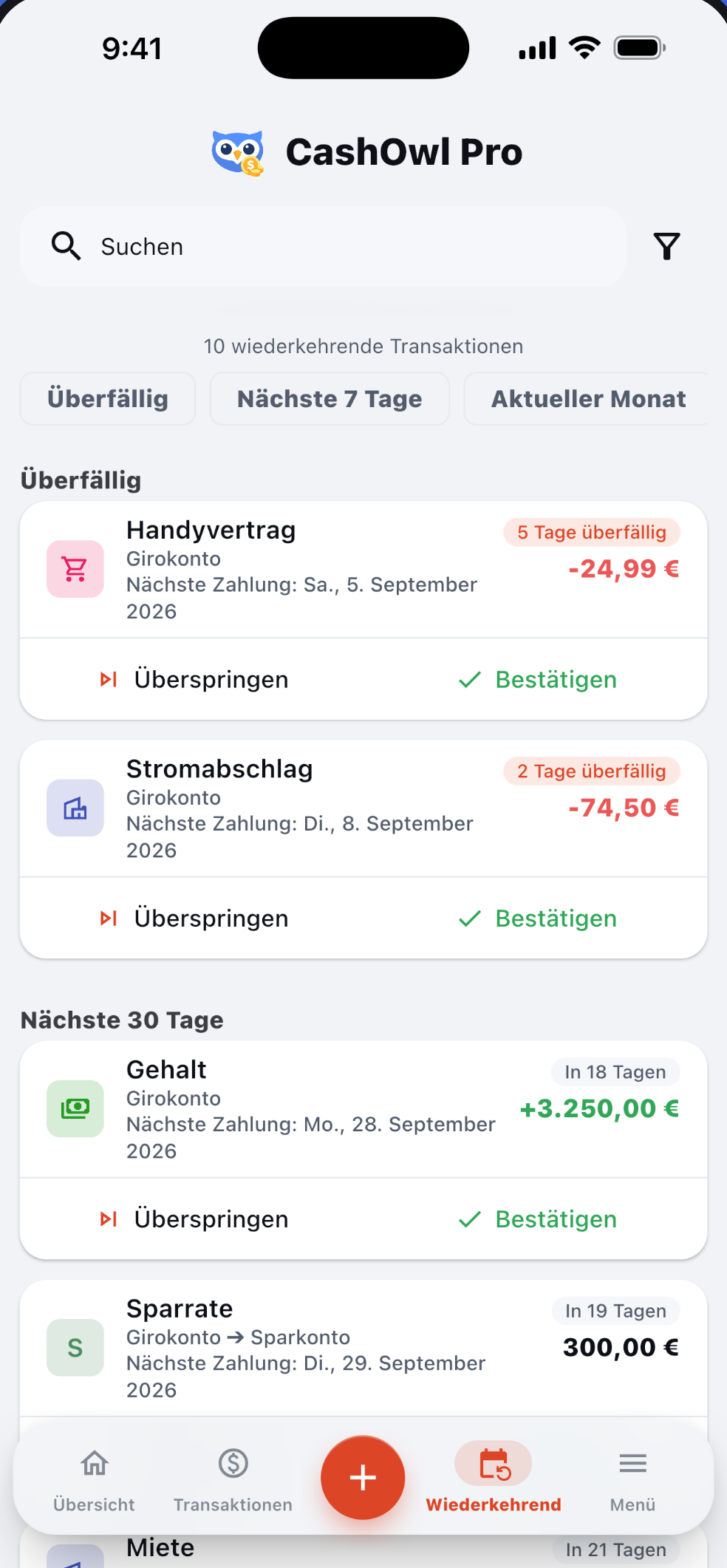
Nicht nur sehen, was war. Wissen, was kommt.
Viele Haushaltsbücher zeigen dir den letzten Monat. CashOwl berücksichtigt auch wiederkehrende Zahlungen, Budgets und finanzielle Verpflichtungen. So erkennst du früher, was in den kommenden Wochen voraussichtlich übrig bleibt.
In Sekunden erfasst
Konto wählen, Betrag eingeben, Kategorie zuordnen. Ergänze bei Bedarf eine Notiz oder weitere Details. Eigene Kategorien, Unterkategorien und Farben passen sich deinem Alltag an – nicht umgekehrt.
Vorausschauen statt nachrechnen
Miete, Gehalt, Versicherungen und Abos legst du einmal an. Budgets, Kalender und Prognose zeigen dir danach, welche Belastungen als Nächstes fällig werden.
Berichte ohne Finanzjargon
Cashflow, Nettovermögen, Sparquote und Kategorie-Trends. CashOwl zeigt Zusammenhänge verständlich – ohne ein Dashboard voller Kennzahlen, die niemand braucht.
Deine Finanzen brauchen keinen Banking-Login.
Für CashOwl ist keine Bankverknüpfung erforderlich. Deine Konten, Buchungen und Budgets werden lokal auf dem Gerät verarbeitet. Eine Cloud-Verbindung ist für die Nutzung nicht nötig.
Optionale Sicherungs- und Synchronisationsfunktionen werden nur aktiv, wenn du sie selbst einrichtest. Für Käufe, Lizenzprüfung oder Support können technische Daten durch die jeweiligen Plattformdienste verarbeitet werden.
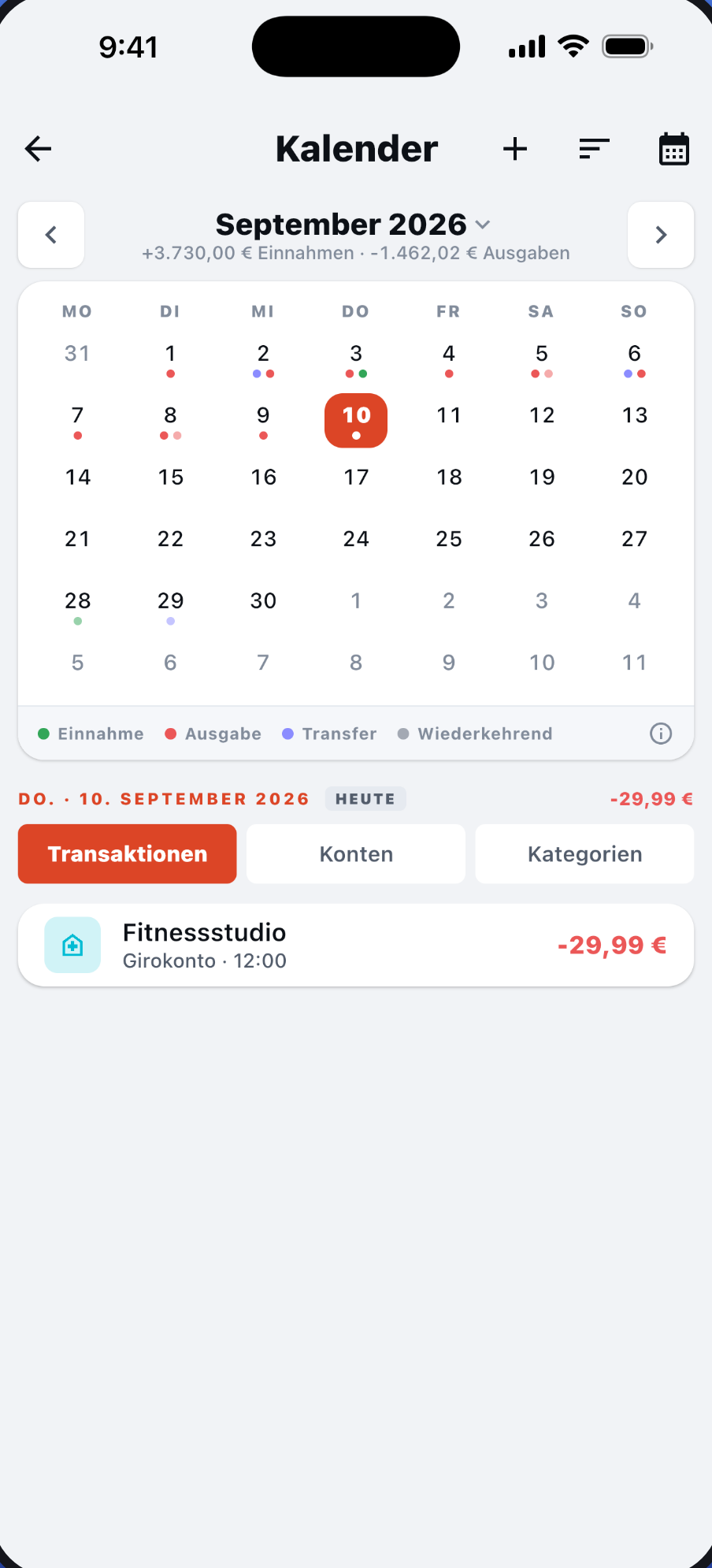
Fixkosten einmal anlegen. Kommende Monate klarer sehen.
Miete, Versicherungen, Streaming, Kredite oder Gehalt: Lege eine wiederkehrende Buchung mit Intervall an und CashOwl führt sie in der Vorschau mit. Überfällige und kommende Zahlungen bestätigst oder überspringst du einzeln.
Berichte, die eine klare Frage beantworten.
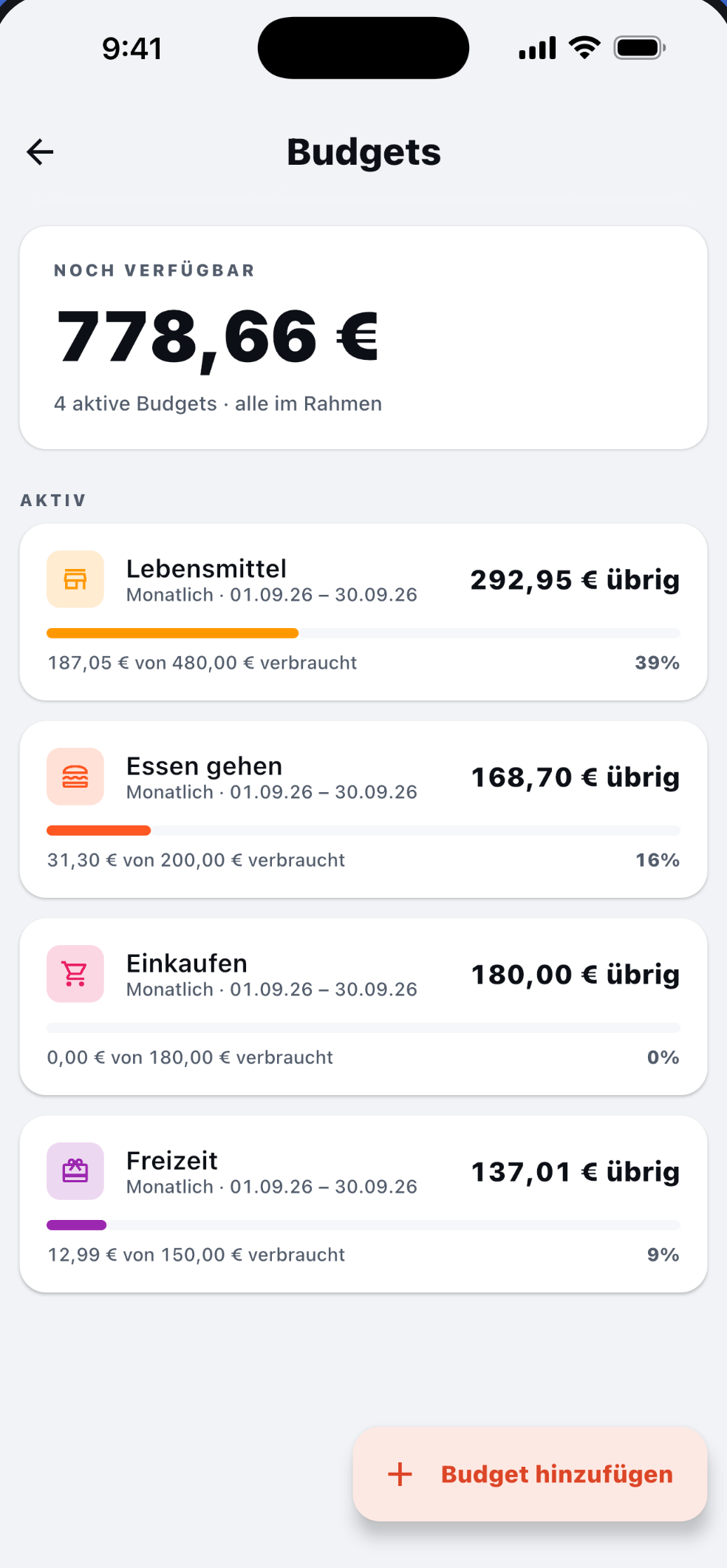
Wohin geht dein Geld? Welche Kategorie wächst? Wie entwickelt sich deine Sparquote? Budgets legst du pro Kategorie, Konto und Zeitraum an – täglich, wöchentlich, monatlich oder jährlich – und siehst laufend, wie viel noch verfügbar ist.
Konten anlegen
Girokonto, Bargeld, Sparkonto. Startsaldo eintragen, Währung wählen, fertig. Ohne Bankzugangsdaten.
Fixkosten hinterlegen
Gehalt, Miete, Versicherungen und Abos als wiederkehrende Buchungen. Das ist die Grundlage für jede Vorschau.
Alltag erfassen
Nach ein paar Wochen zeigen Berichte und Budgets Muster, die vorher niemand ausgerechnet hat.
Kostenlos starten. Pro nur, wenn es dir mehr bringt.
Die kostenlose Version ist dauerhaft nutzbar und hat klare Mengengrenzen. Pro hebt diese Grenzen auf und schaltet zusätzliche Funktionen frei. Aktuelle Preise und Laufzeiten findest du im jeweiligen Store.
Der volle Alltag, mit Mengengrenzen
Ohne Limits, mit Sync und Export
Was Leute vor dem Download wissen wollen.
Muss ich mein Bankkonto verbinden?+
Nein. CashOwl hat keine Bankanbindung. Du legst deine Konten selbst an und erfasst Buchungen manuell oder über wiederkehrende Regeln. Ein Banking-Login wird nie abgefragt.
Funktioniert CashOwl ohne Internet?+
Ja. Erfassen, Budgets, Kalender und Berichte laufen auf den lokal gespeicherten Daten. Eine Verbindung brauchst du nur für optionale Funktionen wie Cloud-Sync, aktuelle Wechselkurse oder einen Kauf.
Brauche ich einen Account?+
Für die Nutzung nicht. Du startest ohne Registrierung. Erst wenn du Cloud-Sync einrichtest, verbindest du den Speicher deiner Wahl mit der App.
Kann ich meine Daten auf mehreren Geräten nutzen?+
Ja, mit Pro. Cloud-Sync gleicht deine Daten geräteübergreifend ab und legt zugleich eine Sicherung an. Ohne Sync bleiben alle Daten ausschließlich auf dem jeweiligen Gerät.
Ist CashOwl kostenlos?+
Der Einstieg ist kostenlos und dauerhaft nutzbar, mit Mengengrenzen bei Konten, Buchungen pro Tag, Budgets und Krediten. Pro hebt diese Grenzen auf. Aktuelle Preise stehen im jeweiligen Store.
Gibt es CashOwl für Android und iPhone?+
Ja. CashOwl gibt es für Android bei Google Play und für iPhone und iPad im App Store.
Aus dem Ratgeber
Alle Ratgeber-Artikel ansehenGeld im Griff. Kopf im Klaren.
Kostenlos starten, ohne Registrierung, ohne Bankzugriff. Pro schaltest du frei, wenn dir die Grenzen der kostenlosen Version zu eng werden.
Alles, was ein Haushaltsbuch können muss.
Von der einzelnen Buchung bis zum Tilgungsplan. Dieser Überblick zeigt, was in CashOwl steckt, was die kostenlose Version umfasst und wo Pro die Grenzen aufhebt.
Einnahmen, Ausgaben, Transfers
Drei Buchungsarten, jede mit Konto, Betrag, Datum, Kategorie und Notiz. Umbuchungen zwischen zwei eigenen Konten zählen nicht als Ausgabe. Einzelne Buchungen lassen sich aus Berichten ausnehmen.
Mehrere Konten, eine Sicht
Girokonto, Bargeld, Sparkonto, Kreditkarte. Jedes Konto mit Startsaldo, eigener Währung, Icon und Farbe. Vermögens- und Verbindlichkeitskonten fließen getrennt in das Nettovermögen ein.
Eigene Struktur statt Vorgabe
Kategorien für Einnahmen und Ausgaben, mit Unterkategorien, Icons, Farben und eigener Reihenfolge. Du baust die Gliederung so, wie du über dein Geld nachdenkst.
Fixkosten und Abos
Regel mit Intervall einmal anlegen. Die App führt überfällige, in sieben Tagen fällige und im laufenden Monat anstehende Zahlungen getrennt auf. Jede Fälligkeit bestätigst oder überspringst du einzeln.
Grenzen, die zu dir passen
Budgets laufen täglich, wöchentlich, monatlich oder jährlich und lassen sich an bestimmte Konten, Kategorien und Buchungsarten binden. Die Übersicht zeigt verbraucht, verbleibend und den Anteil in Prozent.
Der Monat auf einem Blatt
Jeder Tag zeigt an, ob Einnahmen, Ausgaben, Transfers oder wiederkehrende Buchungen anstehen. Über dem Kalender stehen die Summen des Monats, darunter die Buchungen des gewählten Tages.
Cashflow und Nettovermögen
Einnahmen gegen Ausgaben, Entwicklung des Nettovermögens aggregiert oder je Konto, Auswertung nach Kategorie sowie Durchschnitte, Top-Kategorien und Salden als Statistik.
Voraussichtlicher Verlauf
Auf Basis deiner geplanten und wiederkehrenden Buchungen zeigt CashOwl, wie sich dein Saldo voraussichtlich entwickelt. Eine Prognose ist keine Garantie – sie hilft, kommende Belastungen früher zu erkennen. Die volle Prognosetiefe gehört zu Pro.
Raten und Restschuld
Kredite mit Rate, Zinssatz, Laufzeit und Restschuld erfassen und den Tilgungsverlauf verfolgen. Der vollständige Zeitplan bis zur letzten Rate gehört zu Pro. Keine Kreditberatung, nur Darstellung deiner eigenen Zahlen.
Mehrere Währungen
Konten können in unterschiedlichen Währungen geführt werden. Für die Gesamtsicht rechnet CashOwl in deine Basiswährung um; die Kurse lassen sich aktualisieren, wenn eine Verbindung besteht.
Backup und Cloud-Sync
Eine lokale Sicherung kannst du jederzeit anlegen und wiederherstellen. Cloud-Sync gleicht deine Daten zusätzlich geräteübergreifend ab und läuft auch im Hintergrund. Beides richtest du selbst ein; Sync gehört zu Pro.
Den Speicher wählst du: Google Drive, OneDrive, Dropbox, pCloud oder ein eigener WebDAV-Server. CashOwl legt die Sicherung im App-Ordner des Anbieters ab.
App-Sperre, Anhänge, Export
Der Zugriff lässt sich mit PIN oder Biometrie sichern. An Buchungen kannst du Belege und Rechnungen anhängen oder einen Beleg scannen. Diese Funktionen gehören zu Pro.
Buchungen lassen sich als CSV importieren und exportieren, Abrechnungen zusätzlich als PDF. Die Datenbank selbst kannst du als Datei sichern und zurückspielen.
Und die Dinge, die man erst nach Wochen bemerkt.
Ausprobieren geht schneller als weiterlesen.
Die kostenlose Version deckt alle Bereiche ab. Pro schaltest du später frei, wenn dir die Mengengrenzen zu eng werden.
Dein Haushaltsbuch – ohne Zugriff auf dein Bankkonto.
Für einen guten Überblick musst du dein Banking-Passwort nicht an eine Finanz-App weitergeben. Mit CashOwl erfasst du Einnahmen und Ausgaben selbst, verwaltest mehrere Konten und entscheidest, ob du eine Sicherung oder Synchronisation einrichtest.
Warum manche Menschen keine Bankverknüpfung möchten
Wer eine Finanz-App mit dem Konto verbindet, gibt einem weiteren Unternehmen Einblick in jede Abbuchung. Für viele ist das in Ordnung. Für andere ist es eine Schwelle, die sie bewusst nicht überschreiten wollen – aus Datenschutzgründen, wegen der Zugangsdaten oder weil sie schlicht nicht mehr Dienste als nötig einbinden möchten.
Das ist keine Aussage darüber, dass Bankanbindungen unsicher wären. Es ist eine Entscheidung darüber, wer deine Buchungen sieht.
Was das bei CashOwl konkret bedeutet
Manuell erfassen hat einen Preis. Und einen Gegenwert.
Buchungen entstehen nicht von allein. Kartenzahlungen werden nicht automatisch übernommen, und wer zwei Wochen nichts einträgt, hat zwei Wochen Lücke. CashOwl gleicht nichts mit deinem realen Kontostand ab.
Jede Buchung geht durch deinen Kopf, statt in einer automatisch kategorisierten Liste unterzugehen. Bargeld, geteilte Kosten und private Rückzahlungen bildest du so ab, wie sie wirklich laufen – und nicht, wie eine Bank sie sieht.
Wiederkehrende Buchungen nehmen dir den größten Teil der Arbeit ab: Miete, Gehalt, Versicherungen und Abos stehen einmal drin. Bestehende Daten kannst du zusätzlich als CSV importieren.
Offline nutzbar, Cloud freiwillig
Erfassen, Budgets, Kalender und Berichte arbeiten mit den lokal gespeicherten Daten. Ohne Verbindung fehlen dir nur aktuelle Wechselkurse, ein Kauf oder ein Cloud-Abgleich.
Wenn du sichern oder geräteübergreifend synchronisieren willst, wählst du selbst den Speicher: Google Drive, OneDrive, Dropbox, pCloud oder einen eigenen WebDAV-Server. Ohne diesen Schritt verlässt kein Haushaltsbuchdatensatz das Gerät.
Ohne Bankanbindung – was heißt das im Detail?
Kann ich meine Umsätze trotzdem importieren?+
CashOwl kann Buchungen als CSV importieren. Der Export aus deinem Online-Banking oder einer anderen App muss dafür als CSV vorliegen. Eine direkte Verbindung zur Bank gibt es nicht.
Wie lange dauert eine Buchung?+
Konto, Betrag und Kategorie sind die Pflichtangaben; Datum steht auf heute. Notiz, Anhang oder Beleg sind optional. Mit Pro lässt sich ein Beleg scannen, damit die Felder vorausgefüllt werden.
Was passiert bei einem Gerätewechsel?+
Ohne Sicherung bleiben die Daten auf dem alten Gerät. Deshalb lohnt es sich, früh eine Sicherung einzurichten – entweder als lokale Backup-Datei oder über Cloud-Sync mit Pro.
Sieht der Entwickler meine Buchungen?+
Nein. Es gibt keinen CashOwl-Server, auf dem dein Haushaltsbuch liegt. Richtest du Cloud-Sync ein, liegt die Sicherung in deinem eigenen Speicher beim jeweiligen Anbieter, nicht beim Entwickler.
Kein Banking-Login. Kein Account. Keine Werbung.
Du legst deine Konten selbst an und entscheidest, ob überhaupt etwas das Gerät verlässt.
Budget planen, ohne dich an ein Abo zu binden.
CashOwl hat eine kostenlose Version, die dauerhaft nutzbar ist, und Pro-Zugänge, die du nicht brauchst, um anzufangen. Diese Seite sagt genau, wo die Grenze verläuft.
Was die kostenlose Version umfasst – und wo sie aufhört
Alle Kernbereiche sind enthalten: Buchungen, Konten, eigene Kategorien, Budgets, Kalender, Berichte und Kredite. Begrenzt ist nur die Menge.
Das Tageslimit gilt pro Tag, nicht insgesamt: Am nächsten Tag stehen wieder fünf Buchungen zur Verfügung. Gelöschte Konten, Budgets und Kredite geben ihren Platz frei.
Pro hebt sämtliche Mengengrenzen auf und schaltet zusätzlich diese Funktionen frei.
Es gibt Abos. Du musst keines nehmen.
CashOwl bietet zeitlich begrenzte Pro-Zugänge und einen einmaligen Lifetime-Kauf an. Was davon in deinem Store aktuell verfügbar ist und was es kostet, siehst du direkt im Store – Preise und Laufzeiten ändern sich regional und über die Zeit.
Käufe auf Android und iOS laufen über getrennte Plattformen. Ein Kauf im Play Store gilt nicht automatisch im App Store und umgekehrt.
Fragen zu Kauf und Limits
Läuft die kostenlose Version irgendwann ab?+
Nein. Sie ist kein Testzeitraum. Die Mengengrenzen bleiben bestehen, die Funktionen bleiben nutzbar.
Was passiert mit meinen Daten, wenn ein Pro-Zugang endet?+
Deine Daten bleiben vollständig erhalten und lesbar. Neue Einträge über den kostenlosen Grenzen hinaus sind dann nicht mehr möglich, und Pro-Funktionen wie Sync oder PDF-Export sind wieder gesperrt.
Warum steht hier kein Preis?+
Weil Preise regional unterschiedlich sind und sich ändern können. Der Store zeigt dir immer den Preis, der für dich gilt – ein Wert auf dieser Seite wäre schnell falsch.
Gibt es Werbung in der kostenlosen Version?+
Nein. CashOwl zeigt keine Werbung, weder in der kostenlosen Version noch in Pro.
Erst nutzen. Dann entscheiden.
Die kostenlose Version läuft ohne Zeitlimit. Aktuelle Pro-Optionen und Preise siehst du im jeweiligen Store.
Haushaltsbuch für Android, ohne Bankzugriff.
CashOwl ist eine native Android-App im Material-Design. Einnahmen, Ausgaben, Budgets, Fixkosten und Kredite verwaltest du lokal auf dem Gerät – kostenlos startbar, werbefrei und ohne Registrierung.
Was auf Android dazukommt
Sicherung im Hintergrund
Mit Pro läuft der Cloud-Abgleich als geplanter Hintergrundvorgang. Du musst die App nicht öffnen, damit eine Sicherung entsteht.
Entsperren per Biometrie
Die App-Sperre nutzt Fingerabdruck oder Gesichtsentsperrung deines Geräts. Die Prüfung findet auf dem Gerät statt.
Belegscan
Mit Pro liest die Texterkennung Betrag und Datum von einem Beleg aus und füllt die Buchung vor. Die Erkennung läuft auf dem Gerät.
Tägliche Erinnerung
Eine Benachrichtigung zur selbst gewählten Uhrzeit, damit das Erfassen zur Gewohnheit wird. Abschaltbar.
CSV und PDF
Buchungen als CSV importieren und exportieren, Abrechnungen als PDF speichern und über die Systemfreigabe weitergeben.
Käufe über Google Play
Pro-Zugänge und der Lifetime-Kauf laufen über dein Play-Konto. Auf einem neuen Android-Gerät stellst du den Kauf dort wieder her.
Auch als iPhone-Nutzer im Haushalt?
CashOwl gibt es für beide Plattformen mit denselben Funktionen. Käufe sind allerdings an die jeweilige Plattform gebunden und gelten nicht automatisch auf der anderen.
Alle Artikel.
Budgetmethoden, Spartipps und Klartext zu Finanzthemen. Gefiltert nach Kategorie oder chronologisch durchstöbern.
Die Artikel im Ratgeber sind allgemeine Information und keine individuelle Finanz-, Steuer- oder Rechtsberatung. Genannte Beträge sind Beispielrechnungen und keine Zusage über erzielbare Ersparnisse.
Finanzen sollen sich ruhig anfühlen.
Zwischen Excel-Tabelle und Abo-App war Platz.
CashOwl ist aus einer einfachen Beobachtung entstanden: Haushaltsbücher sind entweder Excel-Tabellen oder cloud-hungrige Abo-Apps. Dazwischen gibt es wenig.
Gewollt war eine App, die sich anfühlt wie ein Notizbuch – sofort da, ohne Account – und trotzdem moderne Auswertungen bietet, damit du nicht nur buchst, sondern auch verstehst.
Gebaut als Ein-Mann-Projekt, ohne Risikokapital und ohne Exit-Druck. Das prägt, wofür Zeit da ist: für Kleinigkeiten, die man erst nach Monaten bemerkt – und nicht für Features, die das nächste Pitch-Deck füllen.
Woran wir uns halten.
Deine Zahlen bleiben bei dir
Kein Tracking in der App, keine Bank-Schnittstelle, kein CashOwl-Server für dein Haushaltsbuch. Für Käufe und Lizenzprüfung laufen technische Daten über Google Play oder den App Store – das gehört zum Vertriebsweg und nicht zu deinen Buchungen.
Kein Abo-Zwang
Die kostenlose Version bleibt nutzbar und werbefrei. Pro gibt es als zeitlich begrenzten Zugang oder als einmaligen Lifetime-Kauf – optional, nicht Pflicht.
Geduld beim Handwerk
Updates kommen, wenn sie rund sind – nicht wenn ein Quartal endet. Lieber ein Feature richtig als drei halb.
Probier's aus. Kostenlos.
Schreib uns kurz.
Keine Ticket-Systeme, keine Chatbots – nur eine E-Mail-Adresse. Antwort meist innerhalb von ein bis zwei Werktagen.
In der App hängt diese Funktion deine Geräteinfos automatisch an die E-Mail an. Das spart beiden Seiten Nachfragen.
Datenschutzerklärung
STAND: SEPTEMBER 2026
1. Überblick
CashOwl nimmt den Schutz deiner Daten ernst. Diese Website ist bewusst datensparsam aufgesetzt: keine Werbenetzwerke, keine Analytics-Tracker, keine Social-Media-Plugins, keine Newsletter-Aufnahme.
2. Verantwortlicher
Robert Ehrhardt
Martinstr. 21
04838 Eilenburg
Deutschland
E-Mail: contact@cashowl.app
3. Server-Logfiles
Beim Aufruf dieser Website werden auf unserem Server automatisch Logdaten gespeichert (Zeitstempel, IP-Adresse in gekürzter Form, abgerufene URL, User-Agent, Referer). Rechtsgrundlage ist Art. 6 Abs. 1 lit. f DSGVO (berechtigtes Interesse an Betriebssicherheit). Die Logs werden nach spätestens 14 Tagen gelöscht.
4. Cookies
Diese Website setzt keine Cookies. Die Sprachfassung ergibt sich aus der Adresse der Seite (/de/ beziehungsweise /en/), nicht aus einer Speicherung auf deinem Gerät. Es gibt keine Werbe-, Tracking- oder Third-Party-Cookies und kein Analysewerkzeug — deshalb erscheint auch kein Cookie-Banner. Die verwendeten Schriftarten werden von Google Fonts geladen; dabei wird deine IP-Adresse an Google übertragen.
5. Kontaktaufnahme
Wenn du uns per E-Mail schreibst, werden deine Angaben inklusive der angegebenen Kontaktdaten zur Bearbeitung der Anfrage verarbeitet. Rechtsgrundlage: Art. 6 Abs. 1 lit. b bzw. f DSGVO. Die Daten werden gelöscht, sobald die Anfrage abschließend bearbeitet ist und keine gesetzlichen Aufbewahrungspflichten entgegenstehen.
6. Hosting
Diese Website wird auf einem eigenen, in Deutschland gehosteten Plesk-Server betrieben. Es findet keine Datenübermittlung in Drittländer statt.
7. Deine Rechte
Du hast das Recht auf Auskunft (Art. 15 DSGVO), Berichtigung (Art. 16), Löschung (Art. 17), Einschränkung (Art. 18), Datenübertragbarkeit (Art. 20) und Widerspruch (Art. 21). Anfragen richtest du formlos an die oben genannte E-Mail-Adresse. Beschwerden kannst du an die zuständige Aufsichtsbehörde richten.
8. App-spezifischer Datenschutz
Die CashOwl-App selbst verarbeitet deine Finanzdaten ausschließlich lokal auf deinem Gerät. Informationen zur App-Nutzung findest du in den Stores (Google Play, Apple App Store).
Impressum
Angaben gemäß § 5 TMG
Robert Ehrhardt
Martinstr. 21
04838 Eilenburg
Deutschland
Kontakt
E-Mail: contact@cashowl.app
Verantwortlich für den Inhalt nach § 18 Abs. 2 MStV
Robert Ehrhardt, Martinstr. 21, 04838 Eilenburg
Streitschlichtung
Die Europäische Kommission stellt eine Plattform zur Online-Streitbeilegung (OS) bereit: https://ec.europa.eu/consumers/odr/. Unsere E-Mail-Adresse findest du oben im Impressum. Wir sind nicht bereit oder verpflichtet, an Streitbeilegungsverfahren vor einer Verbraucherschlichtungsstelle teilzunehmen.
Haftung für Inhalte
Als Diensteanbieter sind wir nach § 7 Abs. 1 TMG für eigene Inhalte auf diesen Seiten nach den allgemeinen Gesetzen verantwortlich. Nach §§ 8 bis 10 TMG sind wir jedoch nicht verpflichtet, übermittelte oder gespeicherte fremde Informationen zu überwachen.
Haftung für Links
Diese Website enthält Links zu externen Websites Dritter, auf deren Inhalte wir keinen Einfluss haben. Deshalb können wir für diese fremden Inhalte auch keine Gewähr übernehmen.
Urheberrecht
Die durch die Seitenbetreiber erstellten Inhalte und Werke auf diesen Seiten unterliegen dem deutschen Urheberrecht. Downloads und Kopien für den privaten, nicht-kommerziellen Gebrauch sind gestattet.
{{ aTitle }}
{{ p.text }}
{{ b.x }}
{{ b.x }}
{{ b.x }}
Haushaltsbuch, das passt.
Lade CashOwl und bring den Überblick mit, den du gerade gelesen hast.
Nutzungsbedingungen
VERSION AB 4. JULI 2025
Diese Bedingungen gelten für die CashOwl-App und das Pro-Upgrade.
Nutzungsbedingungen / In-App-Kauf / Upgrade-Informationen
CashOwl beinhaltet ein Pro-Upgrade, welches zusätzliche Funktionen, wie bspw. eine unbegrenzte Anzahl an Einträgen, Login via biometrischer Erkennung und weiteres, anbietet. Das Pro-Upgrade kann dabei als einmaliger (lebenslanger) Kauf oder als automatisch verlängerndes Abo durch einen In-App-Kauf durchgeführt werden.
Android
Der Kauf wird über Ihr Google-Konto abgewickelt.
iOS
Der Kauf wird über Ihr iTunes-Konto abgewickelt.
Keine Gewährleistung
CashOwl lehnt ausdrücklich jegliche Gewährleistung für die App ab. Die App wird „wie besehen“ ohne jegliche ausdrückliche oder stillschweigende Gewährleistung bereitgestellt. CashOwl übernimmt keine Gewährleistung oder Haftung für die Richtigkeit oder Vollständigkeit aller Informationen, Texte, Grafiken, Links oder anderer Inhalte, die Teil der App sind. CashOwl lehnt jegliche Gewährleistung in Bezug auf Schäden ab, die durch die Übertragung von Computerviren, Würmern, Zeitbomben, Logikbomben, Trojanern oder anderen Computerprogrammen dieser Art verursacht werden. CashOwl lehnt auch ausdrücklich die Weitergabe jeglicher Gewährleistung oder Garantie an Benutzer oder Dritte ab.
Haftungsausschluss
In keinem Fall haftet CashOwl für Schäden (einschließlich, aber nicht beschränkt auf, jegliche Art von Gewinnverlust, Betriebsunterbrechung oder Datenverlust). In keinem Fall haftet CashOwl für Datenverlust oder für indirekte, spezielle oder Folgeschäden (einschließlich Gewinnverlust) oder für Schäden aus Verträgen, unerlaubter Handlung/Verhalten oder sonstige Folgen. CashOwl haftet nicht für den Inhalt des Softwareprodukts, einschließlich Verleumdung, Rechte der Allgemeinheit, Privatsphäre, Markenrechte, Betriebsunterbrechung, Körperverletzung, Verlust der Privatsphäre, moralische Rechte oder die Weitergabe vertraulicher Informationen.
Der Benutzer erkennt an, dass die Software möglicherweise nicht frei von Fehlern ist und nicht alle Anforderungen erfüllt. Die Installation und Nutzung erfolgt auf eigenes Risiko.
Obwohl CashOwl unter besten Anstrengungen getestet wird, verwendet es Datenbanktechnologien, die möglicherweise abstürzen oder auch beschädigt werden können (Datenverlust). Der Benutzer ist für etwaigen Datenverlust verantwortlich. Es wird dringend empfohlen, regelmäßig Backups der Datenbank zu machen.
Die Software wird ohne jegliche ausdrückliche oder stillschweigende Gewährleistung zur Verfügung gestellt. In keinem Fall haftet der Autor für Schäden, die durch die Nutzung dieser Software entstehen.
Copyright
Die Software ist Eigentum von Robert Ehrhardt (reneph).
Es ist nicht erlaubt, die Software neu zu kompilieren, zu disassemblieren, zu ändern, zu übersetzen oder zu klonen und ganz oder teilweise unberechtigt einzurichten.
Erklärung zur Barrierefreiheit
Allgemeine Beschreibung
„CashOwl“ ist eine von uns betriebene Smartphone-Applikation im Bereich Produktivität/Finanz-Tools.
Information zum Anbieter gem. Art 246 EGBGB
Robert Ehrhardt, Martinstr. 21, 04838 Eilenburg. E-Mail: contact@cashowl.app
Gesetzliche Anforderungen
Gemäß dem Barrierefreiheitsstärkungsgesetz (BFSG) vom 16. Juli 2021 sind wir verpflichtet, unsere digitalen Dienstleistungen im elektronischen Geschäftsverkehr barrierefrei zu gestalten. Die gesetzlichen Anforderungen ergeben sich insbesondere aus § 14 in Verbindung mit § 3 Abs. 1 BFSG unter Verweis auf die Verordnung zum Barrierefreiheitsstärkungsgesetz (BFSG).
Erfüllung der Barrierefreiheitsanforderungen
Um sicherzustellen, dass unser Angebot für alle Menschen zugänglich ist, ist unsere App gemäß den Web Content Accessibility Guidelines (WCAG) Version 2.2 auf Level AA barrierefrei gestaltet. Wir haben insbesondere folgende Maßnahmen ergriffen:
Die eingesetzten Barrierefreiheitsfunktionen beeinträchtigen die Privatsphäre der Nutzer nicht.
Wir stellen durch regelmäßige Überprüfungen und Anpassungen sicher, dass unsere digitalen Angebote stetig verbessert werden und den gesetzlichen Anforderungen entsprechen.
Aktueller Status der Zugänglichkeit
Unser digitales Angebot ist mit den Anforderungen der Barrierefreiheit vereinbar. Etwaige Barrieren, die wir im Rahmen regelmäßiger Audits identifizieren, werden nach Möglichkeit zeitnah abgebaut.
Zuständige Marktüberwachungsbehörde
Marktüberwachungsstelle der Länder für die Barrierefreiheit von Produkten und Dienstleistungen, Magdeburg, Sachsen-Anhalt.
Haushaltsbuch für iPhone und iPad.
CashOwl läuft auf iPhone und iPad mit demselben Funktionsumfang wie auf Android. Deine Daten bleiben lokal auf dem Gerät, bis du eine Sicherung oder Synchronisation selbst einrichtest.
Was auf iOS dazukommt
iPhone und iPad
Dieselbe App auf beiden Geräteklassen. Auf dem iPad nutzt die Oberfläche die größere Fläche für Listen und Auswertungen.
Face ID und Touch ID
Die App-Sperre nutzt die Biometrie deines Geräts. CashOwl erhält dabei nur die Antwort „entsperrt“, keine biometrischen Daten.
Sicherung im Hintergrund
Mit Pro plant iOS den Cloud-Abgleich als Hintergrundaufgabe ein. Wann genau sie läuft, entscheidet das System.
Eigener Cloud-Speicher
Für Sicherung und Sync wählst du Google Drive, OneDrive, Dropbox, pCloud oder einen eigenen WebDAV-Server.
CSV und PDF
Buchungen als CSV importieren und exportieren, Abrechnungen als PDF über das Teilen-Menü sichern oder versenden.
Käufe über den App Store
Pro-Zugänge und der Lifetime-Kauf laufen über deine Apple-ID und lassen sich auf einem neuen Gerät wiederherstellen.
Wechsel von Android zu iPhone?
Deine Daten nimmst du über Cloud-Sync oder eine Sicherungsdatei mit. Der Kauf wandert nicht mit: Play Store und App Store rechnen getrennt ab.
Diese Seite gibt es nicht.
Vielleicht wurde sie verschoben oder der Link ist unvollständig. Von hier kommst du zurück zum Start oder direkt in den Ratgeber.
Understand your money. Without linking your bank.
Track income and spending, set budgets and see the bills that are coming. CashOwl works offline, with no account and no ads. You set up a backup or sync only if you want one.
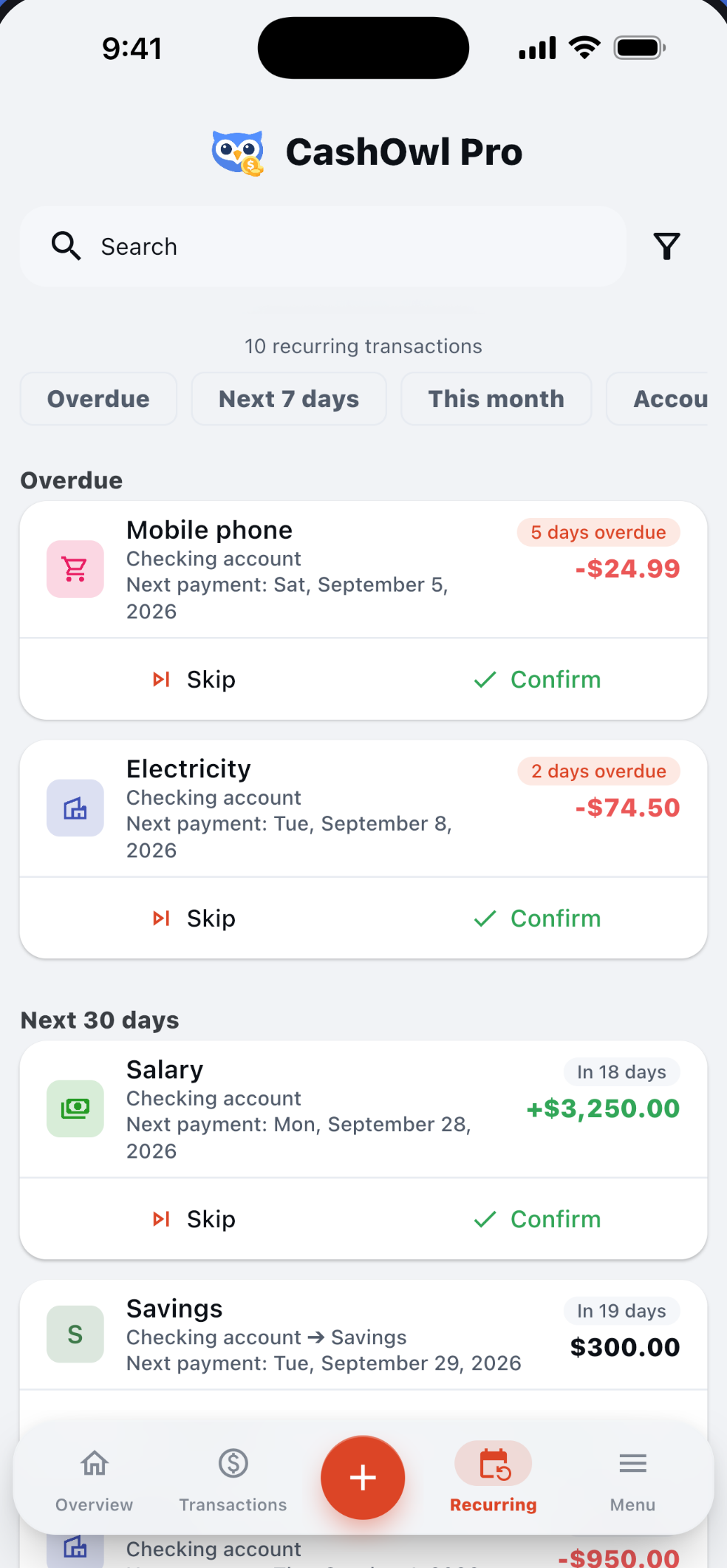
Not just what happened. What happens next.
Most expense trackers show you last month. CashOwl also carries your recurring payments, budgets and loan repayments forward, so you can see earlier what is likely to be left in the weeks ahead.
Logged in seconds
Pick an account, type the amount, choose a category. Add a note or more detail when it matters. Your own categories, subcategories and colours fit how you think.
Look ahead, not just back
Rent, salary, insurance and subscriptions go in once. Budgets, the calendar and the forecast then show you which commitments fall due next.
Reports without the jargon
Cash flow, net worth, savings rate and category trends. CashOwl explains the pattern instead of filling a dashboard with metrics nobody reads.
Your finances do not need a banking login.
CashOwl requires no bank connection. Your accounts, transactions and budgets are processed locally on the device. A cloud connection is not needed to use the app.
Optional backup and sync only start working once you set them up yourself. For purchases, licence checks or support, technical data may be processed by the respective platform services.
Enter fixed costs once. See the months ahead clearly.
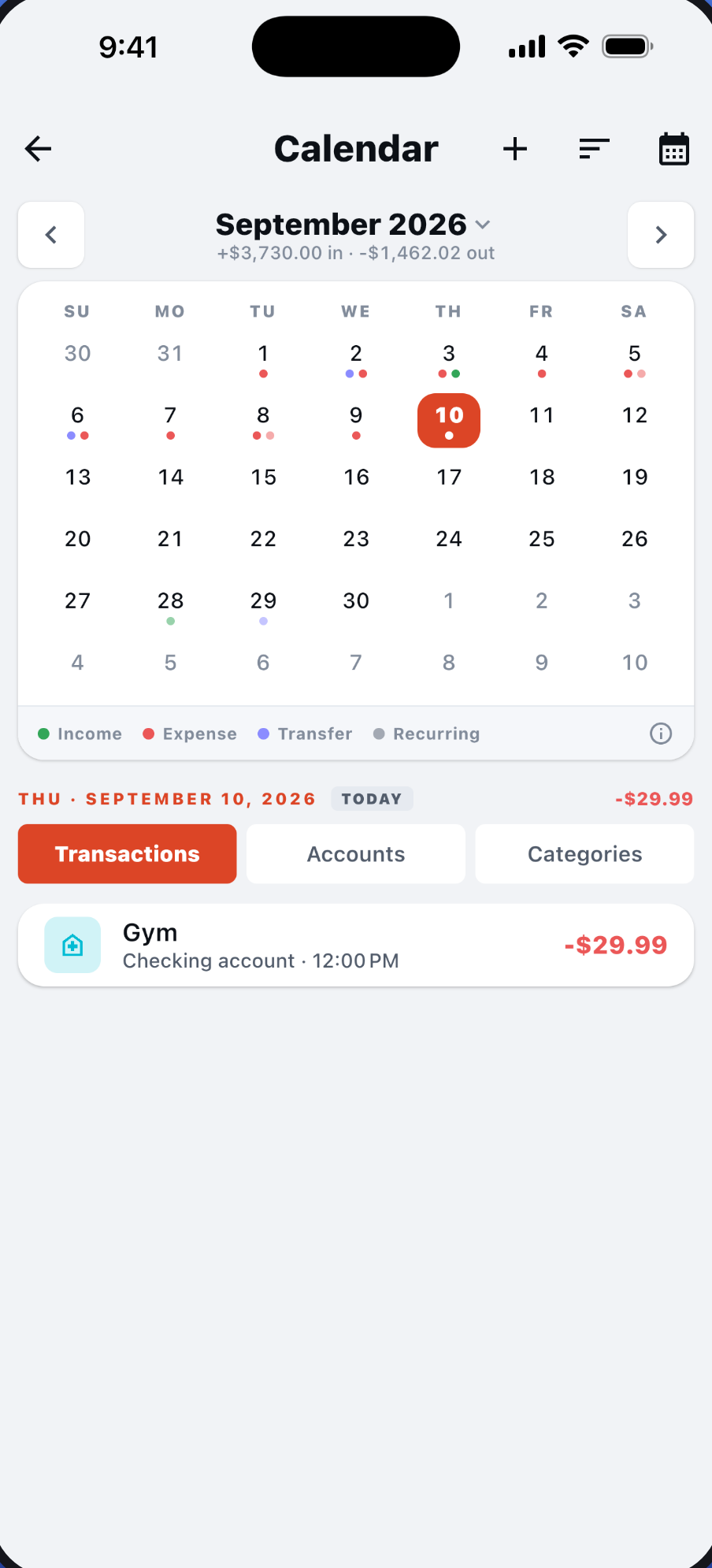
Rent, insurance, streaming, loans or salary: add a recurring entry with its interval and CashOwl carries it into the preview. Overdue and upcoming payments are confirmed or skipped one by one.
Reports that answer one clear question.
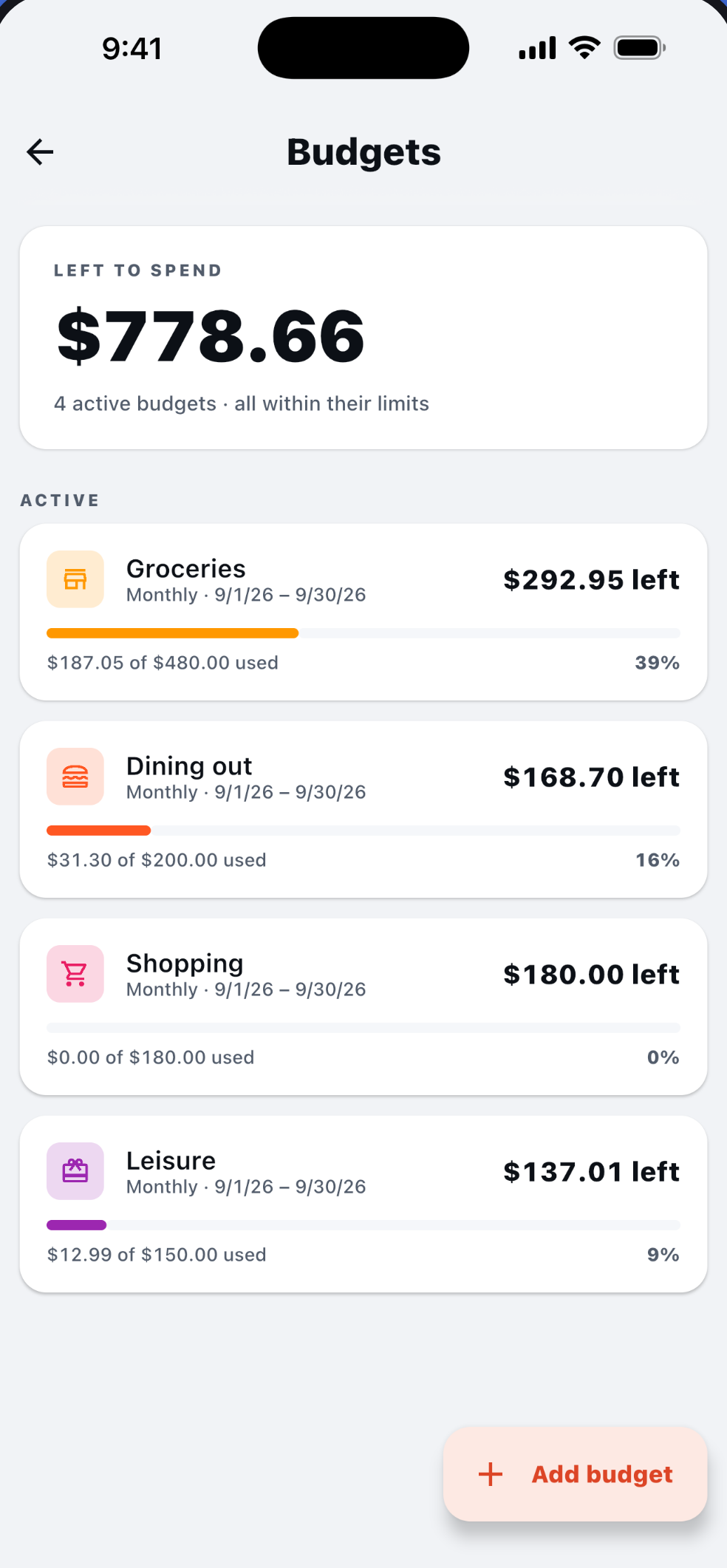
Where does your money go? Which category is growing? How is your savings rate developing? Budgets are set per category, account and period — daily, weekly, monthly or yearly — and show what is still available.
Add your accounts
Current account, cash, savings. Enter the opening balance, pick the currency. No banking credentials involved.
Enter your fixed costs
Salary, rent, insurance and subscriptions as recurring entries. That is what every forecast is built on.
Log the everyday
After a few weeks the reports and budgets show patterns nobody had worked out before.
Start free. Go Pro only if it earns it.
The free version works indefinitely and has clear volume limits. Pro lifts those limits and unlocks additional features. Current prices and terms are shown in your store.
The whole everyday, with volume limits
No limits, plus sync and export
What people want to know before downloading.
Do I have to connect my bank account?+
No. CashOwl has no bank connection. You create your accounts yourself and enter transactions manually or through recurring rules. A banking login is never requested.
Does CashOwl work without internet?+
Yes. Tracking, budgets, the calendar and reports all run on data stored locally. A connection is only needed for optional features such as cloud sync, current exchange rates or a purchase.
Do I need an account?+
Not to use the app. You start without registering. Only when you set up cloud sync do you connect the storage of your choice.
Can I use my data on more than one device?+
Yes, with Pro. Cloud sync keeps your data in step across devices and creates a backup at the same time. Without sync, everything stays on the device it was entered on.
Is CashOwl free?+
Getting started is free and stays usable, with volume limits on accounts, transactions per day, budgets and loans. Pro lifts those limits. Current prices are shown in your store.
Is there a version for Android and iPhone?+
Yes. CashOwl is on Google Play for Android and in the App Store for iPhone and iPad.
From the guides
Money in hand. Head clear.
Start free, with no registration and no bank access. Unlock Pro when the free limits start getting in your way.
Everything an expense tracker actually needs.
From a single transaction to a full repayment schedule. This is what is in CashOwl, what the free version covers, and where Pro lifts the limits.
Income, expenses, transfers
Three entry types, each with account, amount, date, category and note. A transfer between two of your own accounts is not counted as spending. Individual entries can be excluded from reports.
Several accounts, one view
Current account, cash, savings, credit card. Each with an opening balance, its own currency, icon and colour. Asset and liability accounts feed into net worth separately.
Your structure, not a preset
Categories for income and spending, with subcategories, icons, colours and your own ordering. You build the structure the way you think about money.
Fixed costs and subscriptions
Set a rule with its interval once. The app lists overdue items, anything due in seven days and the rest of the current month separately. Each due date is confirmed or skipped individually.
Limits that fit your month
Budgets run daily, weekly, monthly or yearly and can be tied to particular accounts, categories and entry types. The overview shows spent, remaining and the share in percent.
The month on one page
Every day shows whether income, spending, transfers or recurring entries fall on it. Monthly totals sit above the grid, the selected day's entries below it.
Cash flow and net worth
Income against spending, net worth over time aggregated or per account, a breakdown by category, plus averages, top categories and balances as statistics.
The likely path ahead
Based on your planned and recurring entries, CashOwl shows how your balance is likely to develop. A forecast is not a guarantee — it helps you spot commitments earlier. Full forecast depth is part of Pro.
Instalments and balance
Record loans with instalment, interest rate, term and remaining balance, and follow the repayment as it goes. The full schedule to the final payment is part of Pro. No lending advice, just your own figures.
More than one currency
Accounts can be held in different currencies. For the combined view CashOwl converts into your base currency, and rates can be refreshed whenever there is a connection.
Backup and cloud sync
You can create and restore a local backup at any time. Cloud sync additionally keeps devices in step and runs in the background. Both are set up by you; sync is part of Pro.
You pick the storage: Google Drive, OneDrive, Dropbox, pCloud or your own WebDAV server. CashOwl writes into the provider's app folder.
App lock, attachments, export
Access can be protected with a PIN or biometrics. Receipts and invoices can be attached to a transaction, or scanned in. These features are part of Pro.
Transactions can be imported and exported as CSV, statements additionally as PDF. The database itself can be saved as a file and restored.
And the things you only notice after a few weeks.
Trying it takes less time than reading on.
The free version covers every area. Unlock Pro later, when the volume limits start getting in your way.
Your budget app — without access to your bank account.
You do not have to hand your banking password to a finance app to get a clear picture. With CashOwl you enter income and spending yourself, manage several accounts, and decide whether to set up a backup or sync at all.
Why some people would rather not link a bank
Connecting a finance app to your account gives one more company a view of every payment you make. For plenty of people that is fine. For others it is a line they deliberately do not cross — because of privacy, because of the credentials, or simply because they would rather not add services they do not need.
That is not a claim that bank connections are unsafe. It is a decision about who gets to see your transactions.
What that means in CashOwl
Entering things by hand has a cost. And a return.
Entries do not appear by themselves. Card payments are not pulled in automatically, and two weeks of not logging leaves a two-week gap. CashOwl never reconciles against your real balance.
Every entry passes through your head instead of disappearing into an auto-categorised list. Cash, split costs and money lent to friends get recorded the way they actually happened, not the way a bank sees them.
Recurring entries take most of the work off you: rent, salary, insurance and subscriptions go in once. Existing data can also be brought in as a CSV import.
Works offline, cloud entirely optional
Tracking, budgets, the calendar and reports all work from locally stored data. Without a connection you only miss current exchange rates, a purchase, or a cloud sync run.
If you do want a backup or cross-device sync, you choose the storage yourself: Google Drive, OneDrive, Dropbox, pCloud or your own WebDAV server. Without that step, no ledger data leaves the device.
No bank linking — what that means in detail
Can I still import my transactions?+
CashOwl can import transactions as CSV, so an export from your online banking or another app works as long as it is CSV. There is no direct connection to a bank.
How long does one entry take?+
Account, amount and category are the required fields; the date defaults to today. A note, attachment or receipt is optional. With Pro you can scan a receipt and have the fields filled in for you.
What happens when I change phone?+
Without a backup the data stays on the old device. That is why it is worth setting one up early — either as a local backup file or through cloud sync with Pro.
Can the developer see my transactions?+
No. There is no CashOwl server holding your ledger. If you set up cloud sync, the backup sits in your own storage at the provider you chose, not with the developer.
No banking login. No account. No ads.
You create your own accounts and decide whether anything leaves the device at all.
Budget properly, without signing up to a subscription.
CashOwl has a free version that keeps working, and Pro plans you do not need in order to start. This page says exactly where the line runs.
What the free version covers, and where it stops
Every core area is included: transactions, accounts, your own categories, budgets, calendar, reports and loans. Only the volume is capped.
The transaction cap is per day, not a lifetime total: tomorrow you have five again. Deleting an account, budget or loan frees its slot.
Pro removes every volume cap and additionally unlocks these features.
Subscriptions exist. You do not have to take one.
CashOwl offers time-limited Pro plans and a one-time lifetime purchase. Which of them your store currently carries, and what it costs, is shown in the store itself — prices and terms vary by region and change over time.
Android and iOS purchases run through separate platforms. Buying in the Play Store does not carry over to the App Store, or the other way round.
Questions about buying and limits
Does the free version expire?+
No. It is not a trial period. The volume limits stay in place and the features stay usable.
What happens to my data when a Pro plan ends?+
Your data stays complete and readable. New entries beyond the free limits are no longer possible, and Pro features such as sync or PDF export are locked again.
Why is there no price on this page?+
Because prices differ by region and can change. Your store always shows the price that applies to you — a figure here would be out of date quickly.
Are there ads in the free version?+
No. CashOwl shows no advertising, in the free version or in Pro.
Use it first. Decide after.
The free version runs with no time limit. Current Pro options and prices are shown in your store.
An expense tracker for Android, with no bank access.
CashOwl is a native Android app built on Material Design. Income, spending, budgets, fixed costs and loans live locally on the device — free to start, ad-free and with no registration.
What Android adds
Backup in the background
With Pro the cloud sync runs as a scheduled background job. You do not have to open the app for a backup to happen.
Biometric unlock
The app lock uses your device's fingerprint or face unlock. The check happens on the device.
Receipt scan
With Pro, text recognition reads amount and date off a receipt and pre-fills the entry. Recognition runs on the device.
Daily reminder
A notification at a time you choose, so logging becomes a habit. Can be switched off.
CSV and PDF
Import and export transactions as CSV, save statements as PDF and pass them on through the system share sheet.
Purchases via Google Play
Pro plans and the lifetime purchase run through your Play account. On a new Android device you restore the purchase there.
An iPhone in the household too?
CashOwl exists on both platforms with the same features. Purchases, though, belong to the platform they were made on and do not carry across.
Every article.
Budgeting methods, savings tips and plain-English finance writing. Filter by category or browse chronologically.
The guides are general information, not individual financial, tax or legal advice. Any figures quoted are worked examples, not a promise of savings you will achieve.
Money should feel calm.
There was room between a spreadsheet and a subscription app.
CashOwl came out of a simple observation: expense trackers are either spreadsheets or cloud-hungry subscription apps. There is not much in between.
The goal was an app that feels like a notebook — there immediately, no account — while still offering modern analysis, so you do not only log but also understand.
Built as a one-person project, with no venture capital and no pressure to exit. That shapes where the time goes: into small things you only notice after months, rather than features that fill the next pitch deck.
What we hold to.
Your numbers stay yours
No tracking in the app, no bank interface, no CashOwl server holding your ledger. For purchases and licence checks, technical data runs through Google Play or the App Store — that belongs to the distribution route, not to your transactions.
No forced subscription
The free version stays usable and ad-free. Pro comes as a time-limited plan or a one-time lifetime purchase — optional, never required.
Patience with the craft
Updates ship when they are right, not when a quarter ends. Better one feature done properly than three done halfway.
Try it. It's free.
Drop us a line.
No ticketing systems, no chatbots — just an email address. Usually a reply within one or two working days.
In the app this attaches your device details to the email automatically, which saves both sides a round of questions.
Privacy policy
AS OF SEPTEMBER 2026
This is a translation for convenience. The German version is the legally binding text.
1. Overview
CashOwl takes the protection of your data seriously. This website is deliberately data-minimal: no ad networks, no analytics trackers, no social media plugins, no newsletter sign-up.
2. Controller
Robert Ehrhardt
Martinstr. 21
04838 Eilenburg
Germany
Email: contact@cashowl.app
3. Server log files
When you visit this website, log data is stored automatically on our server (timestamp, IP address in shortened form, URL requested, user agent, referrer). The legal basis is Art. 6(1)(f) GDPR, our legitimate interest in operational security. Logs are deleted after 14 days at the latest.
4. Cookies
This website sets no cookies. The language version follows from the page address (/de/ or /en/) rather than from anything stored on your device. There are no advertising, tracking or third-party cookies and no analytics tool — which is why there is no cookie banner. The fonts are loaded from Google Fonts, which transmits your IP address to Google.
5. Getting in touch
If you email us, the details you provide, including your contact details, are processed in order to handle your enquiry. Legal basis: Art. 6(1)(b) or (f) GDPR. The data is deleted once the enquiry has been dealt with conclusively and no statutory retention periods apply.
6. Hosting
This website runs on our own Plesk server hosted in Germany. No data is transferred to third countries.
7. Your rights
You have the right of access (Art. 15 GDPR), rectification (Art. 16), erasure (Art. 17), restriction (Art. 18), data portability (Art. 20) and objection (Art. 21). Requests can be sent informally to the email address above. Complaints can be directed to the competent supervisory authority.
8. Privacy inside the app
The CashOwl app itself processes your financial data exclusively on your own device. Information on app usage is available in the stores (Google Play, Apple App Store).
Imprint
This is a translation for convenience. The German version is the legally binding text.
Details pursuant to § 5 TMG
Robert Ehrhardt
Martinstr. 21
04838 Eilenburg
Germany
Contact
Email: contact@cashowl.app
Responsible for content pursuant to § 18(2) MStV
Robert Ehrhardt, Martinstr. 21, 04838 Eilenburg
Dispute resolution
The European Commission provides a platform for online dispute resolution: https://ec.europa.eu/consumers/odr/. Our email address is given above. We are neither willing nor obliged to take part in dispute resolution proceedings before a consumer arbitration body.
Liability for content
As a service provider we are responsible for our own content on these pages under general law, pursuant to § 7(1) TMG. Under §§ 8 to 10 TMG, however, we are not obliged to monitor transmitted or stored third-party information.
Liability for links
This website contains links to external third-party websites whose content we cannot influence. We therefore cannot accept any liability for that third-party content.
Copyright
The content and works created by the site operator on these pages are subject to German copyright law. Downloads and copies for private, non-commercial use are permitted.
{{ aTitle }}
{{ p.text }}
{{ b.x }}
{{ b.x }}
{{ b.x }}
A ledger that fits.
Download CashOwl and bring the clarity you just read about into your own finances.
Terms of use
VERSION AS OF JULY 04, 2025
These terms apply to the CashOwl app and the Pro upgrade.
Terms of use / In-app purchase / Upgrade information
CashOwl includes a Pro upgrade that offers additional features, such as unlimited entries, biometric login, and more. The Pro upgrade can be purchased either as a one-time (lifetime) purchase or as an automatically renewing subscription via in-app purchase.
Android
The purchase is processed through your Google account.
iOS
The purchase is processed through your iTunes account.
No warranty
CashOwl explicitly disclaims any warranties for the app. The app is provided “as is” without any express or implied warranties. CashOwl makes no warranty or representation regarding the accuracy or completeness of all information, texts, graphics, links, or other content that is part of the app. CashOwl disclaims any warranty for damages caused by the transmission of computer viruses, worms, time bombs, logic bombs, trojans, or other malicious software. CashOwl also explicitly disclaims the transfer of any warranties or guarantees to users or third parties.
Disclaimer of liability
In no event shall CashOwl be liable for damages (including but not limited to loss of profits, business interruption, or data loss). CashOwl shall not be liable for data loss or for indirect, special, or consequential damages (including loss of profits) or for damages arising from contract, tort, or otherwise. CashOwl is not liable for the content of the software product, including defamation, rights of publicity, privacy, trademark rights, business interruptions, bodily harm, loss of privacy, moral rights, or the disclosure of confidential information.
The user acknowledges that the software may not be free of errors and may not meet all requirements. Installation and use are at the user's own risk.
Although CashOwl is tested with best efforts, it uses database technologies that may crash or become corrupted (data loss). The user is responsible for any data loss. Regular backups of the database are highly recommended.
The software is provided without any express or implied warranties. In no event shall the author be liable for damages resulting from the use of this software.
Copyright
The software is the property of Robert Ehrhardt (reneph).
It is not allowed to recompile, disassemble, modify, translate, or clone the software in whole or in part without authorization.
Accessibility statement
General description
“CashOwl” is a smartphone application operated by us in the productivity/finance tool sector.
Provider information according to Article 246 EGBGB
Robert Ehrhardt, Martinstr. 21, 04838 Eilenburg, Germany. Email: contact@cashowl.app
Legal requirements
According to the Accessibility Enhancement Act (Barrierefreiheitsstärkungsgesetz – BFSG) of July 16, 2021, we are obligated to make our digital services in electronic commerce accessible. The legal requirements arise in particular from §14 in conjunction with §3(1) of the BFSG, with reference to the Regulation on the Accessibility Enhancement Act (BFSGV).
Fulfillment of accessibility requirements
To ensure that our services are accessible to everyone, our website is designed to meet the Web Content Accessibility Guidelines (WCAG) version 2.2 at Level AA. In particular, we have implemented the following measures:
The accessibility features implemented do not compromise users' privacy.
We ensure continuous improvement and compliance with legal requirements through regular reviews and updates of our digital services.
Current accessibility status
Our digital offering is compatible with accessibility requirements. Any barriers that we identify through regular audits will be removed as soon as possible.
Responsible market surveillance authority
Market Surveillance Authority of the Federal States for the Accessibility of Products and Services, Magdeburg, Saxony-Anhalt, Germany.
An expense tracker for iPhone and iPad.
CashOwl runs on iPhone and iPad with the same feature set as on Android. Your data stays local to the device until you set up a backup or sync yourself.
What iOS adds
iPhone and iPad
The same app on both device classes. On iPad the interface uses the extra room for lists and analysis.
Face ID and Touch ID
The app lock uses your device's biometrics. CashOwl only receives the "unlocked" answer, never biometric data.
Backup in the background
With Pro, iOS schedules the cloud sync as a background task. Exactly when it runs is up to the system.
Your own cloud storage
For backup and sync you pick Google Drive, OneDrive, Dropbox, pCloud or your own WebDAV server.
CSV and PDF
Import and export transactions as CSV, and save or send statements as PDF through the share sheet.
Purchases via the App Store
Pro plans and the lifetime purchase run through your Apple ID and can be restored on a new device.
Moving from Android to iPhone?
Your data comes with you through cloud sync or a backup file. The purchase does not: the Play Store and the App Store bill separately.
This page does not exist.
It may have moved, or the link is incomplete. From here you can go back to the start page or straight to the guides.